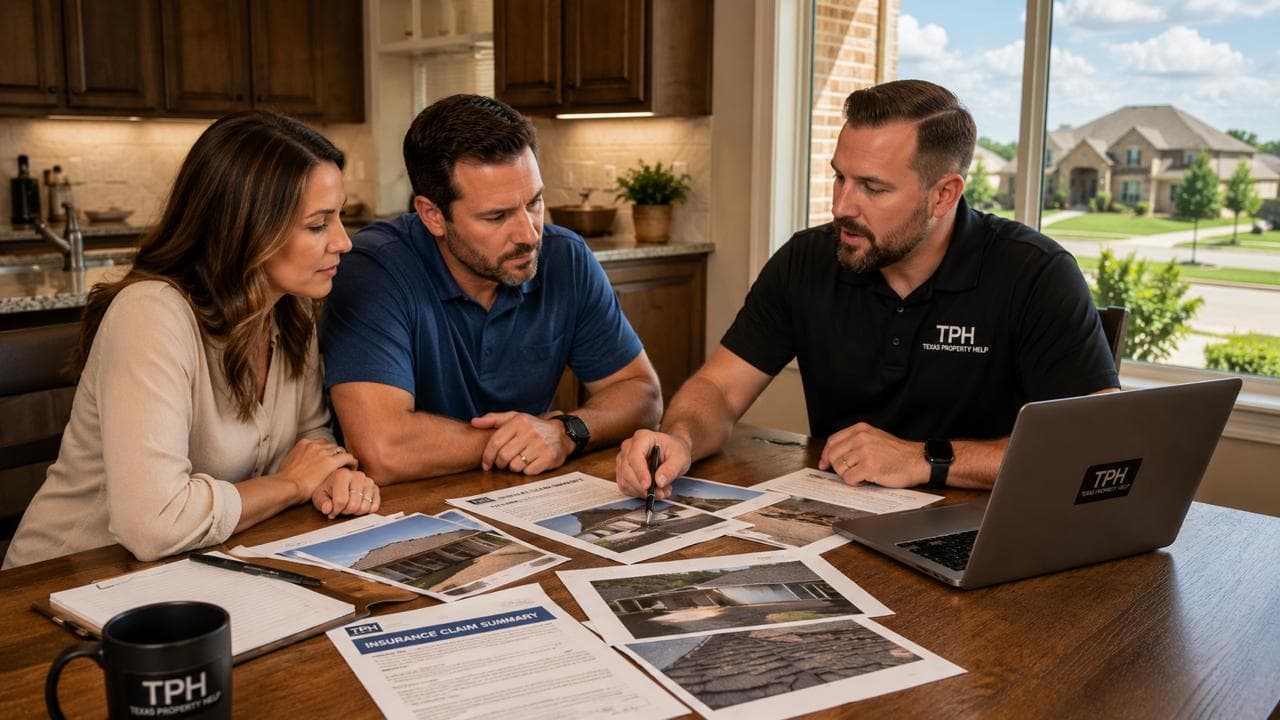
Understanding the Homeowner
Insurance Claim Process
Filing a homeowner insurance claim can feel overwhelming. We provide general homeowner guidance on the process — not legal or insurance advice — to help you navigate with more confidence.
Disclaimer: Nothing on this website constitutes legal advice. If you have legal questions about your insurance policy, contractor dispute, or property rights, please consult a licensed attorney in Texas.
Ask which deadline applies to your claim
Keep the reporting deadline, requests for documents and payment dates in a claim log. Ask the insurer to explain a delay or denial in writing. A repair estimate does not guarantee coverage.
Source: TDI home insurance guide. Checked September 8, 2026.
The General Claims Process
Review Your Policy
Before filing, locate your homeowner's policy declarations page. Note your deductible, coverage type (ACV vs RCV), and any exclusions relevant to your damage type.
Document the Damage
Take thorough photos and video before any cleanup. Document the date, time, and cause of damage. Include interior and exterior damage, and any personal property affected.
Make Temporary Repairs
Prevent additional damage with temporary measures (tarps, board-ups). Keep all receipts — many policies cover reasonable emergency repair costs.
File Your Claim
Contact your insurance company to file the claim. You'll receive a claim number and be assigned an adjuster. Document all communication.
Prepare for the Adjuster Visit
The adjuster will inspect the property. Have your documentation ready. You are permitted to have your own contractor present to point out damage.
Review the Settlement Offer
Your insurer will provide a claim estimate. Review it carefully. If you disagree, you have the right to dispute the amount — consult a licensed public adjuster or attorney if needed.
📎 Key Documents to Keep
- ✓Your insurance policy declarations page
- ✓Claim number and adjuster contact information
- ✓All written and email communication with your insurer
- ✓Photos and video of all damage (dated)
- ✓Contractor estimates and invoices
- ✓Receipts for temporary repairs
- ✓A damage log with dates and descriptions
Disclaimer: Texas Property Help is a homeowner assistance and referral platform. We are not an insurance company, insurance agent, or public adjuster. We do not guarantee claim approval, coverage amounts, or outcomes. All insurance decisions are made solely by your insurance company. Consult a licensed public adjuster or attorney for formal claims assistance.
ACV vs RCV: The Most Important Policy Detail
This single policy detail can mean a $5,000–$15,000 difference on a roof claim for a Texas homeowner. Know which one you have before you file.
Pays the depreciated value of what was damaged. A 15-year-old roof may only be worth 30–40% of replacement cost in your insurer's calculation.
⚠️ You pay the gap between ACV payout and actual repair cost out of pocket.
Pays the actual cost to replace the damaged material with new material of like kind and quality — regardless of the old roof's age.
✓ Typically worth the higher premium — especially on older Texas roofs.
Texas Law
Five Dates to Track in Your Claim
Record when you reported the damage and your policy deadline.
Keep the acknowledgment and claim number.
Log each request for information and your response.
Ask for the decision or an explanation of a delay in writing.
Confirm the payment schedule and its conditions.
Deadlines vary by policy, insurer and circumstances. See the linked TDI guide for response rules and exceptions; this checklist is not a universal legal timeline.
⚠️ Coastal Texas: Check Your Hurricane/Windstorm Deductible
Homeowners in the Texas Gulf Coast region (Houston metro, Corpus Christi, Galveston, Rockport, etc.) may have a separate wind/hurricane deductible that is much higher than their standard all-peril deductible — often 1–5% of your home's insured value. On a $300,000 home, a 2% wind deductible means you pay the first $6,000 before insurance kicks in. Check your declarations page for "windstorm deductible" before you file. If you're in a TWIA area, see our TWIA guide.
Insurance Claim FAQ
Need Help Navigating a Property Insurance Claim?
Submit a request and we'll connect you with resources to help document your damage and understand the general claim process.